
Introduction
Every autumn, I find myself looking for American persimmon along country roads.
Most people drive past them without a second glance. The leaves have begun to fall from the surrounding trees, the fields are turning brown, and the growing season is nearly over. Tucked among old fence rows, abandoned farms and woodland edges, stands one of North America’s finest fruit trees, the American Persimmon.
From a distance, the ripe fruits glow like lanterns suspended among bare branches.
To wildlife, they are a feast.
To people, they are one of the sweetest native fruits in North America. Sweet as caramel and honey.
American Persimmon (Diospyros virginiana) is a tree of patience. It asks little from the gardener once established, tolerates drought, poor soils, heat, and neglect, and may live for generations. Yet its rewards come slowly. Seedlings often spend their first years developing a deep taproot. Fruit may take years to appear. The tree seems content to operate on its own schedule.
When the reward finally arrives, however, it is worth the wait.
A fully ripe persimmon has a flavor unlike any other fruit. Rich, honeyed, and almost custard-like, it has been compared to dates, apricots, pumpkin pie, brown sugar, and maple syrup. The flavor is impossible to describe perfectly because there is nothing else quite like it.
Long before European settlers arrived in North America, Indigenous peoples harvested persimmons for food. Early colonists quickly learned to value them as well. Captain John Smith, among the first Europeans to describe the tree, praised the ripe fruit while warning readers about the consequences of eating one before it was ready.
More than four centuries later, that warning remains excellent advice.
Today, American Persimmon deserves far more attention than it receives. It is a beautiful shade tree, an outstanding wildlife tree, a valuable edible landscape plant, and one of the best native fruit trees available for homeowners throughout much of the eastern United States.
Whether you are interested in wildlife habitat, native landscaping, edible gardening, or simply planting a tree that future generations will enjoy, American Persimmon is worthy of consideration.
American Persimmon Identification
Scientific Classification
Scientific Name: Diospyros virginiana
Common Names: American Persimmon, Common Persimmon, Eastern Persimmon, Possumwood
Family: Ebenaceae (Ebony Family)
Mature Size
American Persimmon typically reaches 35 to 60 feet in height with a spread of 20 to 35 feet, although exceptional specimens may grow larger under ideal conditions.
Young trees often appear narrow and somewhat irregular. With age, the crown becomes broader and more rounded.
Leaves
Leaves are simple, alternate, and oval-shaped with smooth margins.
Each leaf is typically 3 to 6 inches long and dark green above with a lighter underside. During summer, the foliage has a clean, glossy appearance.
Fall color varies considerably from tree to tree and may range from yellow and gold to orange, red, purple, or occasionally remain green until leaf drop.
Flowers
Flowers appear in late spring after the leaves emerge.
They are small, creamy white to pale yellow, and often go unnoticed by casual observers.
Male and female flowers are generally produced on separate trees.
Although not particularly showy, the flowers provide an important nectar source for numerous insects and native bees.
Fruit
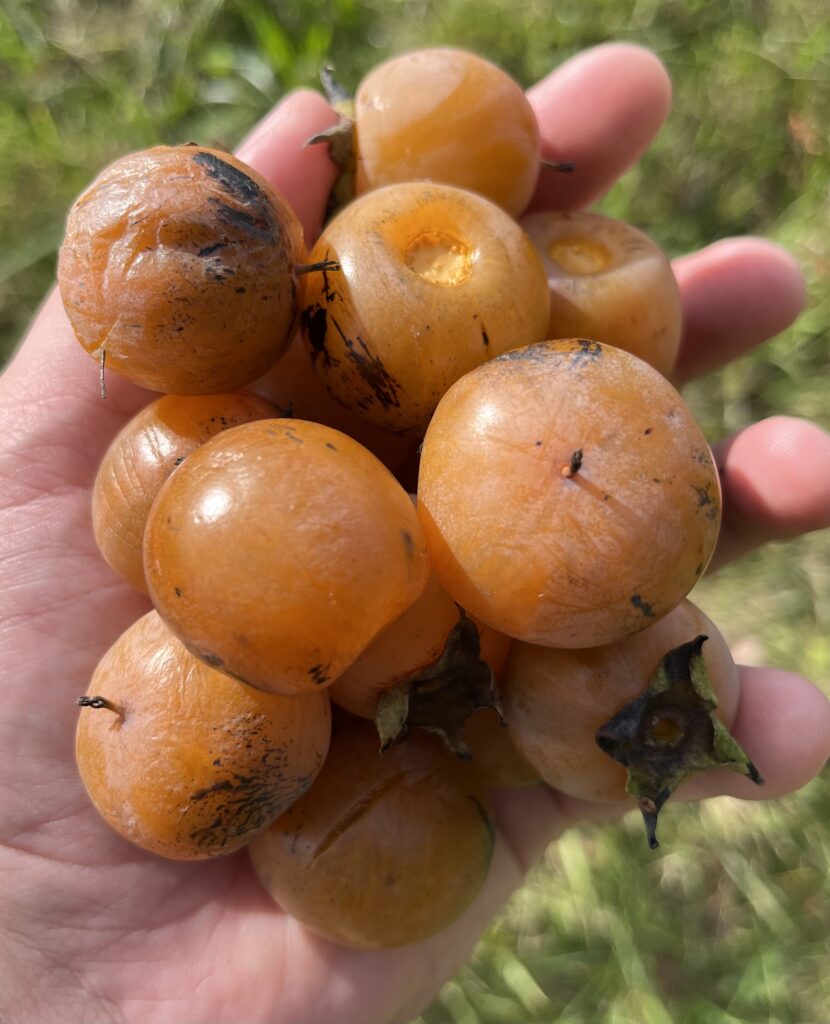
The fruit is the most recognizable feature of the tree.
Persimmons are round to slightly flattened and generally range from 1 to 2 inches in diameter.
Immature fruit is green before gradually turning yellow, orange, or reddish-orange as it ripens.
Ripe fruits become soft and almost translucent.
Unripe fruits contain extremely high levels of tannins and are intensely astringent.
Bark
The bark of mature American Persimmon is among the most distinctive of any eastern tree.
Dark gray to nearly black, it breaks into square, blocky plates resembling alligator skin or charcoal briquettes.
Even in winter, the bark alone is often enough for confident identification.
How to Identify American Persimmon in Winter
Many trees become difficult to identify after leaf drop.
American Persimmon becomes easier.
Look for:
- Dark blocky bark
- Orange fruits hanging after leaf drop
- Zig-zag twigs
- Woodland edges and old fields
- Persistent fruit beneath the tree
The combination is distinctive and difficult to mistake.
Habitat
American Persimmon is native to much of the eastern and central United States.
Its natural range extends from southern New England west into Kansas and south through Texas and Florida.
Throughout this range it occupies a remarkable variety of habitats.
You are most likely to encounter it in:
- Old fields
- Abandoned farms
- Fence rows
- Woodland edges
- Stream terraces
- Bottomlands
- Disturbed ground
- Open forests
Persimmon is often considered an early to mid-successional species.
When farmland is abandoned, persimmon is frequently among the first trees to establish itself.
Over time it becomes part of the developing forest while continuing to provide fruit for wildlife.
One reason for its success is adaptability.
It tolerates:
- Clay soils
- Sandy soils
- Rocky soils
- Seasonal drought
- Summer heat
This flexibility allows it to thrive where many fruit trees struggle.
American Persimmon Wildlife Value
If your goal is supporting wildlife, American Persimmon belongs near the top of your planting list.
Pollinators
The fragrant spring flowers attract:
- Native bees
- Honeybees
- Small pollinating flies
- Beetles
- Wasps
Although the flowers are modest, they provide valuable nectar and pollen resources.
Caterpillar Host Plant
American Persimmon serves as a larval host plant for several moth species, contributing to the food web that supports songbirds and other wildlife.
Birds
Few native fruits attract a wider variety of birds.
Species known to consume persimmons include:
- Wild Turkey
- Cedar Waxwing
- American Robin
- Northern Mockingbird
- Eastern Bluebird
- Yellow-rumped Warbler
- Gray Catbird
Fruit often persists into late fall and early winter, making it particularly valuable when other food sources become scarce.
Mammals
Persimmons are eagerly consumed by:
- White-tailed Deer
- Opossum
- Raccoon
- Red Fox
- Gray Fox
- Coyote
- Black Bear
- Squirrels
The tree’s scientific name could almost be Diospyros opossum considering how closely the fruit is associated with opossums.
Ecological Importance
Persimmon occupies an important niche in eastern ecosystems because it produces abundant, energy-rich fruit during a season when wildlife is preparing for winter.
Few native trees provide such a concentrated source of carbohydrates in late autumn.
For that reason alone, persimmon deserves wider planting.
American Persimmon Historical Uses
Long before European settlers arrived in North America, Indigenous peoples throughout the eastern United States harvested persimmons as an important seasonal food.
The ripe fruits were eaten fresh, dried for winter storage, or incorporated into breads and other foods. Because the fruits ripen in autumn and often persist into early winter, they provided an important source of carbohydrates at a time when many other wild foods were becoming scarce.
Early European settlers quickly adopted the fruit.
One of the earliest written descriptions comes from Captain John Smith, who explored the Chesapeake Bay region in the early 1600s. He praised the fruit’s flavor while warning that unripe persimmons would “draw a man’s mouth awry with much torment.”
More than four hundred years later, that description remains remarkably accurate.
Persimmons became a familiar food throughout rural America. Families collected the fruit after the first frosts of autumn and used it in puddings, breads, preserves, and fermented beverages.
In many regions, persimmon pudding became a cherished local tradition. Recipes were passed down through generations and remain popular today.
The wood was valued as well.
American Persimmon belongs to the ebony family, and its wood is unusually dense, hard, and strong. Historically it was used for:
- Golf club heads
- Textile shuttles
- Tool handles
- Mallet heads
- Turned wood products
- Specialty woodworking
Before modern synthetic materials became common, persimmon wood was considered one of the finest domestic hardwoods available.
Today, most people know persimmon for its fruit, but historically it was valued both as a food source and as a useful timber tree.
American Persimmon Edible Uses
For many people, American Persimmon produces the finest fruit of any native North American tree.
That statement may seem bold until you’ve eaten a fully ripe persimmon.
The fruit becomes incredibly soft when ripe. The texture resembles custard or pudding more than a typical fruit. The flavor is rich, sweet, and complex, with notes often compared to:
- Apricot
- Date
- Honey
- Brown sugar
- Maple syrup
- Pumpkin pie
- Dried fig
No two trees taste exactly alike.
Seed-grown persimmons exhibit tremendous genetic variation. Some produce larger fruit. Others produce richer flavor. Some ripen earlier. Others hang on the tree well into winter.
Harvesting American Persimmon
The biggest mistake beginners make is harvesting too early.
A persimmon may appear orange and fully colored yet still be completely unripe.
Fruit should be harvested only when:
- Soft
- Slightly wrinkled
- Easily detached
- Nearly jelly-like
Many experienced foragers simply collect fruit that has naturally fallen.
Processing Persimmons
To prepare persimmons:
- Wash ripe fruit.
- Remove stems.
- Separate seeds from pulp.
- Strain if desired.
- Use immediately or freeze.
Frozen pulp maintains excellent quality and allows the harvest to be enjoyed throughout the year.
Traditional Recipes
American Persimmon has been used for:
- Persimmon pudding
- Persimmon bread
- Persimmon cookies
- Persimmon cake
- Persimmon pie
- Persimmon jam
- Persimmon butter
- Persimmon ice cream
- Persimmon wine
- Persimmon beer
For many people, persimmon pudding remains the classic preparation.
Nutritional Value
Persimmons contain:
- Vitamin A
- Vitamin C
- Dietary fiber
- Antioxidants
- Natural sugars
The fruit provides an excellent source of energy for both people and wildlife during autumn.
American Persimmon Growing Conditions
One reason American Persimmon deserves wider planting is its adaptability.
Many fruit trees demand constant attention.
Persimmon does not.
Hardiness Zones
USDA Zones 4-9
Sunlight
American Persimmon performs best in full sun.
Trees growing in full sun generally:
- Produce more fruit
- Grow faster
- Develop better crown structure
Partial shade is tolerated, particularly when young.
Soil
Persimmon grows in:
- Clay soils
- Sandy soils
- Loamy soils
- Rocky soils
Ideal soil is:
- Moist
- Well-drained
- Moderately fertile
The species tolerates poor soils far better than most fruit trees.
Moisture
Young trees benefit from regular watering during establishment.
Established trees become surprisingly drought tolerant because of their deep root systems.
Soil pH
American Persimmon adapts to a wide pH range but generally performs best between 6.0 and 7.5.
Growth Rate
Young seedlings often appear slow.
This can frustrate gardeners.
However, much of the tree’s early energy goes into developing a deep taproot.
Once established, growth often accelerates.
Deer Resistance
No persimmon should be considered deer resistant.
Young trees are frequently browsed.
Protect newly planted trees with:
- Tree tubes
- Wire cages
- Deer fencing
Once trees grow above browse height, damage becomes less severe.
Maintenance
Maintenance requirements are low.
Typically all that is needed is:
- Mulching
- Occasional watering during drought
- Protection from deer during establishment
Few native fruit trees are easier to maintain.
American Persimmon Propagation
American Persimmon is one of the most rewarding native trees to grow from seed.
Seed Collection
Collect fully ripe fruits during autumn.
Remove pulp and wash seeds thoroughly.
Healthy seeds are typically chestnut brown and smooth.
Stratification
Persimmon seeds require cold moist stratification.
A common method is:
- Place seeds in moist sand or peat
- Seal in a plastic bag
- Refrigerate for 60-120 days
Many growers stratify seeds throughout winter.
Germination
Seeds are usually planted in spring.
Persimmons develop a strong taproot almost immediately.
Because of this, deep containers are strongly recommended.
Shallow trays often produce distorted root systems.
Seedling Care
Seedlings prefer:
- Bright light
- Consistent moisture
- Good drainage
Growth may seem modest during the first year.
This is normal.
The tree is investing heavily in root development.
Transplanting
Smaller trees transplant far more successfully than larger ones.
The taproot develops quickly and becomes increasingly difficult to move as the tree ages.
Whenever possible:
Plant young.
Grafting
Named cultivars are propagated by grafting.
Grafting allows growers to reproduce:
- Fruit size
- Flavor
- Ripening season
- Seed count
- Tree characteristics
For fruit production, grafted trees provide greater consistency than seed-grown trees.
Companion Plants
American Persimmon rarely grows alone in nature.
It is most successful as part of a larger plant community.
Creating those same relationships in the landscape results in healthier and more resilient plantings.
Companion Trees
Pawpaw (Asimina triloba)
Another exceptional native fruit tree that naturally occurs in many of the same regions.
American Plum (Prunus americana)
Provides spring flowers and summer fruit while supporting pollinators and wildlife.
Serviceberry (Amelanchier spp.)
Produces fruit months before persimmon, extending the harvest season.
Red Mulberry (Morus rubra)
A valuable native fruit tree with outstanding wildlife benefits.
Companion Shrubs
Spicebush (Lindera benzoin)
Supports Spicebush Swallowtail butterflies and thrives in woodland-edge habitats.
Arrowwood Viburnum (Viburnum dentatum)
Provides berries for birds and excellent habitat value.
American Hazelnut (Corylus americana)
Produces edible nuts while contributing structure and diversity.
Elderberry (Sambucus canadensis)
Provides fruit for wildlife and people.
Companion Wildflowers
Aromatic Aster (Symphyotrichum oblongifolium)
Late-season pollinator resource.
Goldenrods (Solidago spp.)
Among the most important native pollinator plants.
Cardinal Flower (Lobelia cardinalis)
Brilliant red flowers that attract hummingbirds.
Butterfly Weed (Asclepias tuberosa)
Supports Monarch butterflies and numerous native pollinators.
Companion Grasses
Little Bluestem (Schizachyrium scoparium)
Provides nesting habitat and year-round structure.
Switchgrass (Panicum virgatum)
Excellent wildlife cover and erosion control.
Together these species create a landscape that functions more like a natural ecosystem than an isolated planting.
Frequently Asked Questions
How long does it take an American Persimmon tree to bear fruit?
Seed-grown trees typically begin producing fruit in 6-10 years, though some may fruit earlier or later. Grafted trees often produce sooner.
Do you need a male and female persimmon tree?
Usually yes. American Persimmon is generally dioecious, meaning male and female flowers occur on separate trees.
Do persimmons need frost before harvest?
No.
The fruit needs ripeness, not frost.
Frost may help soften fruit, but fully ripe fruit can occur without freezing temperatures.
Are American Persimmon messy?
They can be.
Fruit often drops beneath the tree during autumn.
Plant them where fallen fruit will not create problems on sidewalks, patios, or driveways.
Are American Persimmon good for wildlife?
They are among the best native wildlife trees in eastern North America.
Few species provide more food for birds and mammals during autumn.
Can American Persimmon grow in clay soil?
Yes.
The species is highly adaptable and performs surprisingly well in clay soils provided drainage is reasonable.
Are American Persimmons self-pollinating?
Most are not.
For reliable fruit production, a male tree should be present near female trees.
Why does my persimmon tree not have fruit?
Common causes include:
- Tree is too young
- Tree is male
- Lack of pollination
- Excessive shade
Can American Persimmon be grown from seed?
Absolutely.
In fact, many wild trees originated from seeds dispersed by wildlife.
Is American Persimmon worth planting?
If you value native plants, wildlife habitat, edible landscaping, and resilient trees, American Persimmon is one of the finest trees you can plant.
Final Thoughts
The American Persimmon is a tree that rewards patience.
It spends years building roots before investing heavily in growth. Waits until autumn to display its greatest gift. Asks little from the gardener and gives generously to wildlife.
In a world increasingly filled with plants selected for immediate gratification, American Persimmon reminds us that some of the best things take time.
Plant one for yourself.
One for wildlife.
Plant one for the next generation.
And someday, perhaps years from now, someone walking beneath its branches on an autumn afternoon will discover a perfectly ripe persimmon and understand exactly why this remarkable native tree has been treasured for centuries.